

City guide
Pančevo — a Banat city one bridge from Belgrade
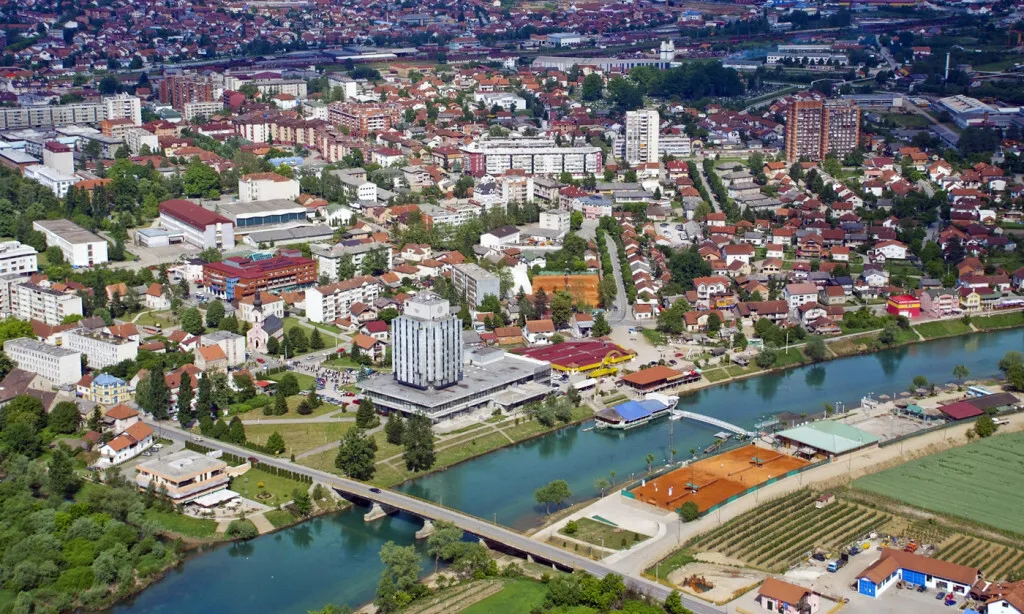
South Banat on the Tamiš: close enough to Belgrade for a daily commute, old enough to hold the best-preserved Habsburg military-frontier core of any Serbian town its size. Road and railway share a single bridge to the capital.
- Official €/m²
- 1,337 €/m²
- New developments
- 4
- Landmarks
- 16
Overview
South Banat begins where the Tamiš runs into the Danube, and Pančevo sits on the left bank just above the confluence, some 17 km north-east of central Belgrade, in Vojvodina. Nothing interrupts the horizon in any direction: the town stands 77 m above sea level, with no hill for 40 km. The Census 2022 count of 115,454 residents covers the whole administrative city — nine villages and about 756 km² included — rather than the town on its own.
Ask what the place is and two answers come back at once: a Banat city with a history of its own, and produženo predgrađe Beograda, Belgrade's extended suburb. The 013 dialling code and PA plates are worn as badges. Behind the petrochemical plants that drivers notice first stands the best-preserved Habsburg military-frontier core of any Serbian town its size.
History
From 1739 to 1918 the Danube here was an international frontier: Habsburg on this bank, Ottoman and later Serbian Belgrade on the other.
Austria organised the Banat Military Frontier in the 1760s and made the town seat of the 12th German-Banat border regiment; the Historical Archive's oldest records begin in 1765. A petition carried to Vienna by the wheelwright Jozef Urban and the merchant Nikola Rusović won the merged Serbian and German municipalities free military communitas status from Francis II in 1794. Civic institutions came quickly after — the Serbian Church Choral Society in 1838, said to be the oldest surviving in present-day Serbia; the weekly Pančevac from 13 April 1869; the first Serbian printing house, opened by Kamenko and Pavle Jovanović in 1870. Industry arrived late: Azotara's fertiliser works at Vojlovica in November 1962, the refinery in late 1968, five more petrochemical plants between 1977 and 1981. On the Jabuka road, Stratište marks one of the largest Holocaust-era killing sites in Serbia.
What makes it special
What sells the town is its scale — low-rise, walkable, near enough to the capital to commute daily. The Habsburg core is protected as a single spatial entity, Staro gradsko jezgro, taking in Trg kralja Petra I, Trg slobode and the streets that link them, with façades, windows and shopfronts all regulated.
No city territory in Serbia is richer in cultural monuments: 55 protected, three of them of exceptional importance and thirteen of great importance. Errands stay on foot: the Gradska uprava and its service centre on Trg kralja Petra I, with APR, PIO, RFZO, the treasury and eighteen bank branches a few hundred metres off. The pollution reputation deserves correcting rather than repeating.
On 2025 measurements the annual particulate means sit on a par with central Belgrade's, and the winter problem measured is household solid-fuel heating, not the refinery. Residents skew settled and middle-aged: at the 2022 census the average resident age was 43.6 years, with 20.5% holding a higher-education qualification.
Living here
Almost everything the centre does happens on foot, along Trg kralja Petra I — the korzo — and on through Njegoševa, Zmaj Jove Jovanovića, Masarikova and Nikole Tesle to Trg Đorđa Vajferta. The evening promenade is a real institution, and on Friday and Saturday the crowd is thickest.
Summer shifts the whole business west to the Tamiš embankment, Kej Radoja Dakića, with benches, grills, a playground, an outdoor fit park, a fenced dog park and a renovated path running about 2.5 km to the lighthouses. Working hours start and finish earlier than in Belgrade, bakeries open before dawn, Sunday trading is brief.
Two seasonal facts to plan around: the košava, a squally south-easterly off the Đerdap gorge that settles in for two or three days at a time, and the mosquitoes, which the city fights with an annual larviciding and spraying programme. Newcomers find the place friendly but slow to open; the 128 clubs registered with Sportski savez Pančevo are the practical way in.
Green space & outdoors
Day to day it is the Tamiš that counts; the Danube frontage is port and industrial edge. Across the water lies Gradska šuma, some 300 hectares of two-century-old floodplain forest — white poplar, ash, oak — with 63 bird species, a heron colony and black stork, and the waymarked Stari Tamiš trail along the old river course.
No bridge; you cross by small boat from the town quay. Two yellow-brick lighthouses of 1909 stand at the confluence, dark since the 1960s and protected since 1972. For running or gravel cycling, the 90 km dyke around the drained Pančevački rit polder is the best flat traffic-free surface locally.
Further out: Park prirode Ponjavica, Danube oxbows protected since 1995, with a tower and no motorboats; Ivanovačka ada, a natural monument since 2009; Kačarevačko jezero, the lake beach families actually use. The 2025 bathing report recommended no monitored river site, and there are no lifeguards; the indoor pool at SRC Strelište is the year-round answer.
Food & drink
Cured pork sets the tone — slanina, kobasica, kulen, čvarci — over a Central European base with a paprika accent: paprikaš, gulaš, winter sarma, riblja čorba, štrudla for cake. Older loanwords linger on menus: rinflajš, grenadirmarš, taške, šmarn. Zelena pijaca on Oslobođenja is the main green market — dairy, fish and pastry halls, producers selling banatski sir — with satellites at Strelište, Tesla, Kotež and Sodara.
Restaurants line Njegoševa and Vojvode Radomira Putnika between Trg kralja Petra I and Trg slobode; 134 restaurants and cafés citywide, 1.16 per 1,000 residents. Čarda Šajka sits across the Tamiš in the Gradska šuma: ring the bell at the jetty and a boat comes.
Brewing runs from the 1722 concession to Abraham Kepiš, the oldest in the Balkans by local reckoning, to today's Dilemma craft brewery; the Weifert complex is a gutted ruin, shut to the public. Treći prostor and Coffee District do specialty coffee; Slaninijada at Kačarevo, 12 km north, each February pulls the municipality's biggest crowd.
Culture & events
Narodni muzej Pančevo, founded in 1923 by Dr Branislav Jankulov and installed in the Magistrat on Trg kralja Petra I since 1965, holds a version of Paja Jovanović's Seoba Srba, works by Uroš Predić, the restored 1848/49 flag of the Serbian Vojvodina, and the Okovano stablo, the nail-studded trunk that is the city's guild emblem. Kulturni centar Pančeva and Dom omladine complete the three publicly funded houses that carry the year.
Galerija savremene umetnosti, founded in 1976, turns fifty in 2026 and moved premises in 2024; Galerija Milorada Bate Mihailovića rotates more than 2,000 works lent by the heirs of the Paris-based painter; a private museum of veteran motorcycles opens by arrangement.
Gradska biblioteka Pančevo, from 1923, is the matična library for eight South Banat municipalities. The calendar repeats: Bijenale umetnosti in even years, Internacionalni karneval in June, the Pančevački Jazz Festival in late October, Klasik Fest in the Roman Catholic church, Ex Teatar Fest, Dan grada on 8 November, and the city slava, Velika Gospojina, on 28 August.
Schools & services
Schooling is the strong suit: twenty-one primaries and eight secondaries. Gimnazija „Uroš Predić“ grew from an 1851 Realschule upgraded in 1863, in a protected 1888 building; Mihajlo Pupin studied there, Uroš Predić completed all seven years, Miloš Crnjanski taught there in 1921–22. Elektrotehnička škola „Nikola Tesla“ runs four-year IT profiles: a technical secondary without commuting.
Higher education is the honest gap: one private dental school since 2002, then a commute to Belgrade or Novi Sad. Preschool demand at PU „Dečja radost“ outruns supply, about 700 children waiting; new kindergartens go up in Mladost and Strelište. Opšta bolnica Pančevo, a secondary-level general hospital, has obstetrics but no cardiac surgery, neurosurgery or radiotherapy; nineteen Dom zdravlja branch surgeries cover the districts and villages.
Sport runs deep: 139 facilities mapped — SRC Strelište for pool and hall, SRC Mladost for clay courts, Barutana for skating and what the city calls Serbia's first concrete climbing wall; FK Železničar plays SuperLiga. BIG Pančevo handles mall shopping; 57 pharmacies citywide.
Getting around
Most routes to the capital funnel onto one crossing. The Pančevački most opened on 10 November 1935, destroyed in 1941, rebuilt by 1946: 1,526 m, two road lanes each way plus a single railway track. Heavy goods vehicles have been barred since September 2021; reconstruction of the approaches should start in spring 2027; the alternative Ada Huja crossing, promised since 2003, remains unbuilt.
Rail is the dependable option — Pančevo Glavna to Beograd Centar in 24 minutes, west to Novi Beograd and Zemun since 2025, four stops inside the city (Glavna, Varoš, Strelište, Vojlovica), much thinner on Sundays and holidays. BG Voz stops short at Ovča.
Pantransport runs buses to Beograd Dunav and Blok 42; Belgrade city transport has been free since 1 January 2025. Driving is roughly 23 minutes free-flow, double that in the morning peak; the Pupinov most via the Severna tangenta is longer but bypasses the bridge. Cycling across is effectively impossible, though EuroVelo 6 runs along the Banat bank.
The property market
Housing comes in four layers: the Austro-Hungarian core (Centar, Gornji grad — locally Margita — and Donji grad); 1960s–80s estates for the industrial workforce (Tesla, Kotež 1 and 2, Strelište, Sodara, Mladost); co-operative self-build at Misa, Nova Misa and Kudeljarski nasip; and the absorbed settlements (Vojlovica, Topola, Skrobara).
New-build achieved an average 1337 €/m² in 2024, against an average net monthly salary of 1041 € in April 2026; permits ran at 1201 dwellings per year as of 2025, completions at 791 in 2024. Kotež and Tesla have district heating, parking and schools on foot; Gornji grad backs onto the Gradska šuma, the built-up district furthest from the refinery; Strelište is the value pick with a rail halt.
Vojlovica and Topola sit a kilometre from the former fertiliser plant, and are cheap for it. Old unrenovated core stock carries the widest discount; buying off-plan discounts a completed unit further. Of the nine villages only Starčevo works as a suburb; the districts here are urban areas, not statistical municipalities.
Day trips
South Banat's day trips need no Danube crossing, while most of Serbia's famous destinations sit beyond the Pančevački most. Kovačica, a Slovak village 30 km out, produced self-taught farmer-painters collected internationally; its gallery, founded 15 May 1955, was the first village gallery in Yugoslavia; Kovačica naive painting entered the UNESCO Representative List of Intangible Cultural Heritage on 3 December 2024. Idvor keeps Mihajlo Pupin's birth house, the 1843 school and the 1935 Narodni dom. Vršac, 66 km, raises a real mountain from the plain — Gudurički vrh, 641 m, Vojvodina's highest point — plus the Banat wine region at Gudurica and the Mesić monastery. Bela Crkva has gravel-pit lakes, lifeguarded in season; Ram fortress, reopened in 2019, comes via the Banatska Palanka ferry, halted by weather and ice.
Kovin, Smederevo, Zrenjanin, Carska bara and Viminacium fit a day. Deliblatska peščara burned in 2026; check access. Timișoara, European Capital of Culture in 2023, needs a passport, not an ID card. Saturday nights mostly happen in Belgrade.
Landmarks
The area in numbers
Full statistics- Official price per m² (RZS)
- 1,337 €/m²January 2024
- Average net salary
- 1,041 €April 2026
- Population (2022 census)
- 115,454January 2022
- Building permits (year)
- 1,201January 2025