

City guide
Kragujevac
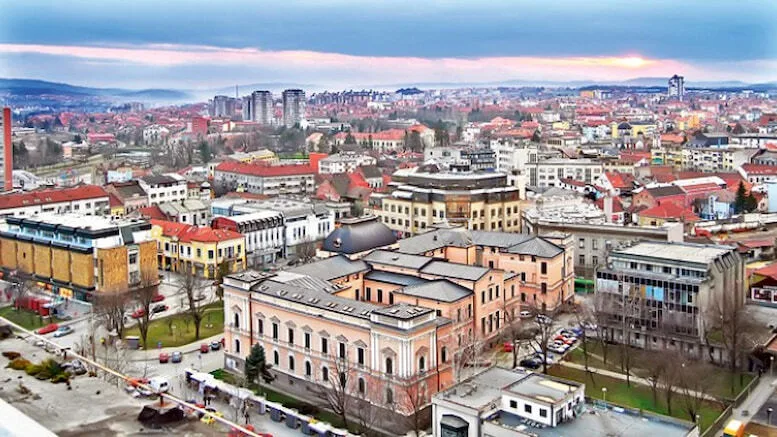
Kragujevac is the largest city of Šumadija and Serbia's first modern capital, today a compact university and industrial centre of 171,186 people. It offers big-city services at small-city scale, with a lot of green space and an ageing, settled population.
- Official €/m²
- 1,383 €/m²
- New developments
- 8
- Landmarks
- 12
- Municipalities
- 5
Overview
Kragujevac sits in the hills of Šumadija, in the heart of central Serbia, on the Lepenica river. At the 2022 census it had 171,186 residents, and it remains the administrative, economic and university centre of the region.
Stari Grad, Centar, Pivara, Aerodrom and Erdoglija are names of districts rather than separate administrative units, and in daily life the city reads as one continuous town: a dense nineteenth-century core, rings of housing blocks around it, and the large Zastava car works sitting immediately south-west of the centre rather than out on the periphery. Kragujevac is big enough to have its own university, hospital and theatre, and small enough to learn quickly.
History
The city's modern importance begins in 1818, when Prince Miloš Obrenović made it the capital of the Principality of Serbia. Over the following two decades the institutions of the young state were founded here: the country's first grammar school in 1833, the Knjaževsko-srpski teatar in 1835, and the Sretenje Constitution, proclaimed the same year.
The capital moved to Belgrade in 1841, and Kragujevac reorganised itself around the military arsenal established in the 1850s, which grew into the Zastava works and made the city the centre of Serbian car manufacturing. In October 1941 German forces shot large numbers of civilians here; the site is now the Šumarice memorial park. The decades after 2000 brought painful industrial restructuring and a partial recovery.
What makes it special
The honest question is what you gain by not being in Belgrade. There is a university, there are hospitals, courts and a theatre, and 23.9% of residents hold a higher-education qualification — the professional layer that keeps those institutions staffed. Healthcare provision is comparatively dense at 0.57 points per 1,000 residents, and there are 1.08 restaurants or cafés per 1,000.
It suits families, people working in health, education, public administration and industry, and anyone who wants urban life without a daily commute. It suits less well those who need a deep and varied labour market, frequent international travel, or the cultural range of Belgrade. An average resident age of 43.5 years also describes a city that is ageing rather than filling up with newcomers.
Living here
Daily life is handled locally rather than downtown: 122 supermarkets, 67 pharmacies and 35 schools are spread across the city's districts, along with 11 kindergartens and five university sites. Eating out is a real part of the routine — 185 restaurants and cafés for a city this size — and most of them cluster along the pedestrian main street and around the old core.
Green space is unusually good: 77 parks are recorded, from Veliki park in the centre to the wooded expanse of Šumarice on the northern edge, which is both a memorial site and the city's main place to walk and run. With 175 sports facilities and 23 cultural venues, the city is more active than its population suggests.
Getting around
Kragujevac is a car city with a walkable middle. The old core, the pedestrian main street and most public institutions sit close together, so a central address genuinely cuts down on driving. Beyond that, city buses are the only form of public transport; there is no tram or trolleybus.
The key link is the road east to the A1 (E75) motorway at Batočina, which puts Belgrade and Niš within a comfortable drive, while roads west lead towards Kraljevo and the Ibar valley. Rail runs on a branch line via Lapovo and is secondary to intercity coaches, which are frequent and go almost everywhere. The nearest international airport is Belgrade's; the Aerodrom district is named after a former airfield, not a working one.
Landmarks
The area in numbers
Full statistics- Official price per m² (RZS)
- 1,383 €/m²January 2024
- Average net salary
- 995 €April 2026
- Population (2022 census)
- 171,186January 2022
- Building permits (year)
- 704January 2025
Municipalities
- Aerodrom
Aerodrom is a residential district of Kragujevac, the largest city of the Šumadija region in central Serbia. It is somewhere to live rather…
- Centar
The historic and administrative core of Kragujevac: compact, walkable, and dense with institutions, culture and older housing.
- Erdoglija
A settled residential district of Kragujevac, close to the city centre and built up mainly during the industrial decades of the twentieth…
- Pivara
A city municipality of Kragujevac, named after the brewery. Close to the centre, mixed between housing and industry, and best judged street…
- Stari Grad
The old town of Kragujevac: the earliest layer of the city, gathered around Prince Miloš's court quarter, quieter and lower than the…