

City guide
Niš
Serbia's third city and the centre of its south: a walkable core by the fortress, a full university and clinical centre, and 249,501 residents across five municipalities.
- New developments
- 22
- Landmarks
- 17
- Municipalities
- 5
Overview
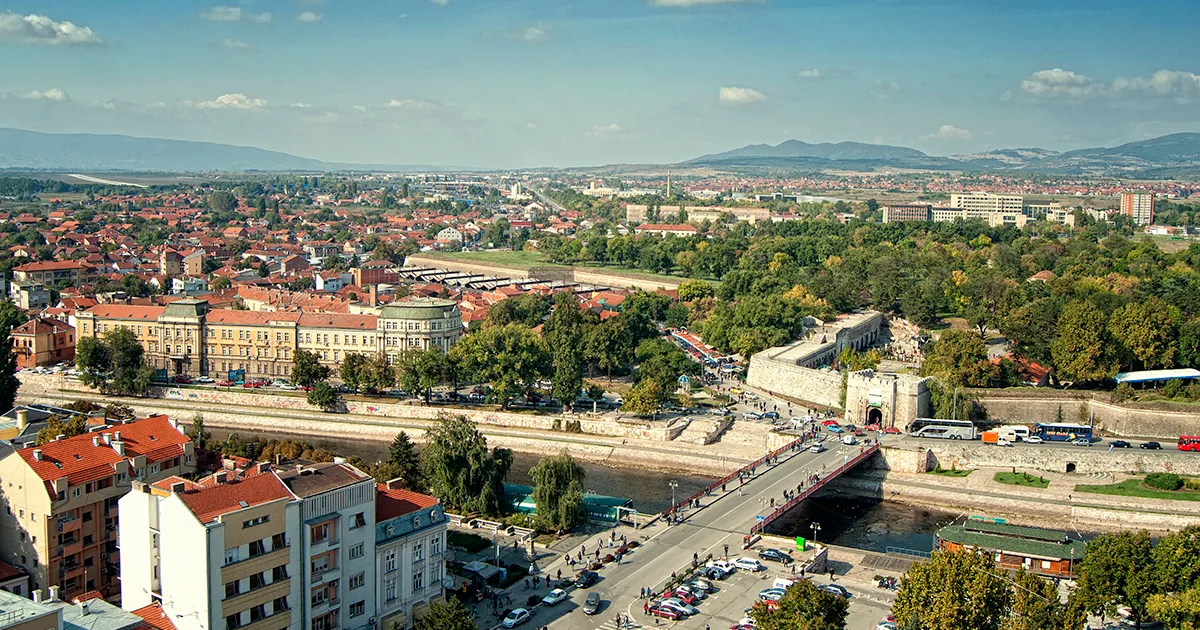
Niš lies in south-eastern Serbia, on the Nišava shortly before it joins the South Morava, in a broad basin closed in by hills. It is the country's third city and the centre of gravity for the whole south: people from the surrounding towns come here for work, for the hospital, for the university.
The 2022 census counted 249,501 residents spread across five municipalities — Medijana at the core, with Palilula, Pantelej and Crveni Krst around it, and the spa municipality of Niška Banja to the east. The character is that of a real city at a manageable scale: a compact, flat, walkable centre by the fortress, then residential districts that thin out into countryside within a few kilometres.
History
Niš is one of the oldest continuously inhabited places in the Balkans. As Roman Naissus it guarded the road between the Danube and Constantinople, and it was the birthplace of Constantine the Great, whose residence at Mediana stood on that road east of town. Stefan Nemanja took Niš from Byzantium in the 1180s; two centuries of medieval Serbian rule followed, then five under the Ottomans; the fortress on the north bank of the Nišava and the Ćele Kula, built from the skulls of Serbian fighters after the battle of Čegar in 1809, both date from that period.
Niš passed to Serbia in 1878 and grew quickly as a railway junction. The twentieth century added industry — electronics, tobacco, machine building — and the housing blocks that came with it. Most of that industry is gone; the university, the clinical centre and services carry the city now.
What makes it special
The case for living in Niš is scale. It has the institutions of a large city — a full university, the clinical centre for southern Serbia, a serious cultural calendar — inside a place you can cross in twenty minutes. Average net pay was 1011 € in spring 2026, and the housing market is not stagnant: 1,943 dwellings were permitted in 2025 and 1,695 completed in 2024, so new stock is genuinely coming onto the market.
Nearly a third of residents, 30.2%, have higher education. It suits people whose work is portable or tied to the university, the hospital or the IT sector, and families who want everything within reach. It suits you less if you need a deep specialised job market or frequent international travel; the average resident age of 43.4 years reflects how many young people still leave.
Living here
Daily life is easy to organise. There are 153 supermarkets, 77 pharmacies and 40 hospitals and clinics across the city, plus 68 schools and 25 kindergartens — 0.27 schools per 1,000 residents. Eating out is a local strength: 303 restaurants and cafés, 1.21 per 1,000 people, and Niš takes its grill and its burek seriously, with the old tinkers' alley, Kazandžijsko sokače, filling up in the centre each evening.
Green space is plentiful, with 147 parks and open areas, while the fortress grounds and the Nišava embankment do the work of a central park; 260 sport facilities are mapped. Nišville brings jazz to the fortress every August. The population is mixed and ageing — average age 43.4 — with students refreshing the centre during term.
Getting around
Niš is the road junction of the Serbian south. Corridor 10 passes here: the E75 runs north to Belgrade and south towards Skopje and Thessaloniki, and the E80 branches east to Sofia, which puts both borders within an easy drive. The main railway line follows the same axes, with the station close to the centre.
Constantine the Great Airport sits just outside the built-up area, with a modest but useful set of flights. Inside the city, buses cover all five municipalities and the centre itself is flat and walkable; you can live in Medijana without a car. Further out — the upper reaches of Pantelej and Palilula, the villages of Crveni Krst, Niška Banja to the east — a car becomes the practical answer.
Landmarks
The area in numbers
Full statistics- Average net salary
- 1,011 €April 2026
- Population (2022 census)
- 249,501January 2022
- Building permits (year)
- 1,943January 2025
Municipalities
- Crveni Krst
The north-western municipality of Niš, where city blocks give way to the airport, the motorway corridor and a belt of villages. Affordable…
- Medijana
Medijana is the central municipality of Niš: the city's administrative, academic and commercial core, plus the dense residential boulevards…
- Niška Banja
A spa municipality on the eastern edge of Niš, where thermal baths, parkland and gorge villages take the place of city density. Quiet and…
- Palilula
A large, mixed city municipality on the south-western side of Niš, urban near the centre and rural at its edges. Cheap by Serbian…
- Pantelej
One of the five city municipalities of Niš, Pantelej runs from housing blocks on the north side of the Nišava up into hill villages. It…